
Texas Pacific: Custom Braille Office Signage for Accessible Workplace Environments

1. Project Overview
YIJIAO provided a complete custom office signage system for the Texas Pacific project in the United States, including desk nameplates, room number signs, and floor directional signs.
Designed around an accessibility-first approach, the signage system combines double-layer acrylic panels with raised acrylic lettering to provide clear visual identification and tactile readability. The structure is designed to withstand frequent contact in everyday office environments while maintaining a clean, professional appearance.
One of the key features of this project is the replaceable insert design, which allows text to be updated without replacing the entire sign. This provides greater flexibility for changing employee names, room information, and office layouts.
From design development to sample validation, mass production, and delivery, YIJIAO coordinated the project through a comprehensive manufacturing and delivery process. Standardized quality control helped ensure that the signage system followed the project’s specifications and design expectations.
2. Project Background
Office signage needs to serve different users and support a wide range of everyday activities.
For the Texas Pacific project, the signage system needed to clearly identify individual workstations, meeting rooms, offices, and floor directions while providing accessible information for people with visual impairments.
Beyond visual appearance, the project required careful consideration of tactile readability, product durability, and ease of future maintenance.
Traditional fixed-text office signs can become costly and inconvenient when employee names, room functions, or office layouts change. Replacing an entire sign simply to update a few words creates unnecessary material waste and increases maintenance costs.
To address these challenges, YIJIAO developed an integrated custom signage solution featuring raised acrylic lettering, a double-layer acrylic structure, and replaceable information inserts.
The project aimed to create a consistent and accessible office signage system that could accommodate future information changes while maintaining a professional appearance throughout the workspace.
3. Project Challenges
3.1 Achieving the Desired Brass Color
The client requested a specific brass-colored finish for the signage.
However, no exact color reference or standardized color code was available at the beginning of the project. Achieving the desired appearance therefore required careful color development and repeated adjustments.
The challenge was to reproduce the client's preferred brass tone consistently while ensuring that the finished signs maintained a uniform appearance across different signage types.
3.2 Balancing Accessibility with Visual Design
The signage needed to combine tactile identification with clear visual information.
The raised acrylic lettering and double-layer structure had to provide a practical tactile experience while maintaining the clean and professional appearance expected in a modern office environment.
3.3 Designing for Future Information Changes
Employee names, room names, and office functions can change over time.
The signage system needed to support easy text replacement without compromising the stability, appearance, or durability of the finished signs.
The replaceable insert mechanism also needed to be practical for future maintenance while remaining secure and neatly integrated into the overall structure.
4. Our Solution
4.1 Custom Brass Color Development and Sample Approval
During the drawing and design stage, YIJIAO prepared preliminary color samples based on the client's desired brass finish.
The samples were sent to the client for evaluation. Based on their feedback, we adjusted the paint color and prepared additional samples until the preferred appearance was confirmed.
By completing color development before mass production, we helped establish a consistent visual reference for the entire signage system.
This process also reduced the risk of color discrepancies during production and ensured that the finished signs aligned with the client's expectations.

4.2 Double-Layer Acrylic Structure with Raised Lettering
The signage system uses a double-layer acrylic structure combined with raised acrylic text.
This design provides dimensional lettering for tactile identification while maintaining clear visual contrast and a refined appearance.
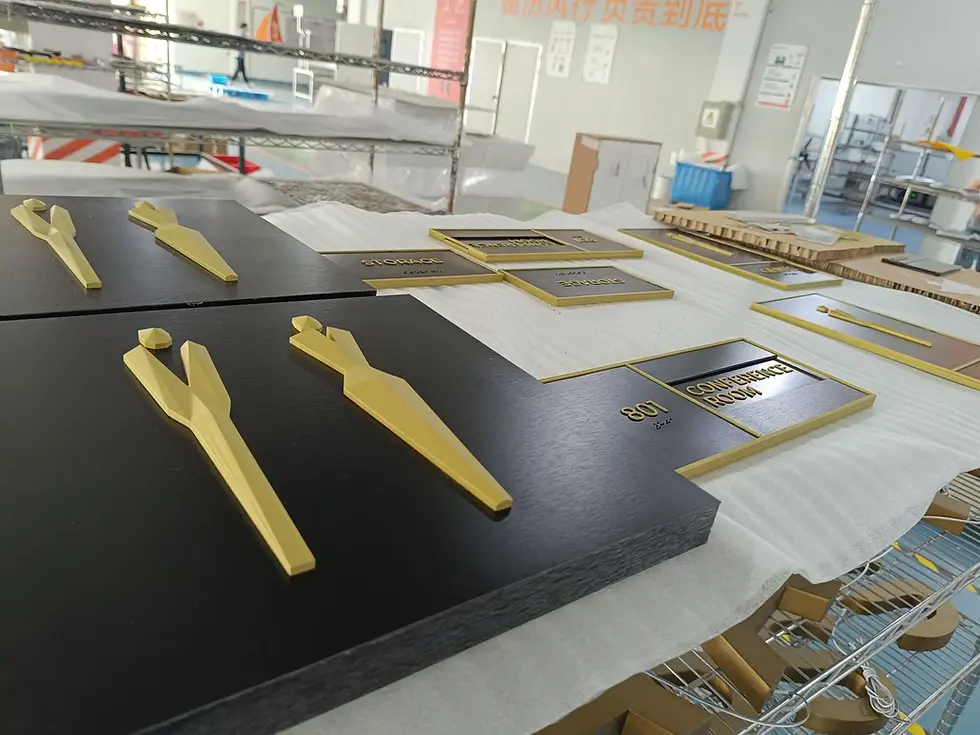
The combination of materials and structure was selected to support the project's accessibility requirements and everyday office use.
The final design integrates tactile functionality with the overall visual language of the office environment.
4.3 Replaceable Insert Design
One of the most important features of this project is the replaceable information insert system.
Instead of permanently fixing all information to the sign, the design allows the relevant text insert to be removed and replaced when information changes.
This provides several practical advantages:
Simpler information updates: Employee names, room names, and other changing information can be updated more conveniently.
Reduced replacement costs: When only the text changes, the entire sign does not need to be replaced.
Greater flexibility: The system can accommodate future office layout changes and personnel adjustments.
Less material waste: Replacing only the information insert helps reduce unnecessary material consumption throughout the signage system's service life.
Easier maintenance: The replaceable design simplifies future updates while preserving the appearance of the main sign structure.
By separating changing information from the permanent sign structure, YIJIAO created a signage solution better suited to the evolving needs of modern office environments.
4.4 Sample Validation Before Mass Production
Before proceeding with the full project, YIJIAO arranged sample production for each signage design.
The samples were completed and sent to the client for review and approval.

This allowed the client to verify the design, color, materials, structure, and replaceable insert function before mass production began.
Only after the samples were confirmed did we proceed with the full production process.
This step helped ensure that the final signage system remained consistent with the approved designs and project requirements.
5. Project Results
The Texas Pacific project demonstrates how accessible office signage can combine functionality, visual consistency, and long-term flexibility.
Improved accessibility: Raised acrylic lettering supports tactile identification and accessible navigation.
Consistent appearance: Desk nameplates, room signs, and directional signs share a unified design.
Flexible information management: Replaceable inserts simplify future updates without replacing entire signs.
Durable construction: Double-layer acrylic and raised lettering provide a practical solution for everyday office use.
Coordinated project delivery: YIJIAO managed the process from design and sample approval to production and delivery.
6. Project Insights
The Texas Pacific project highlights the importance of combining accessibility, visual design, and future maintenance requirements in custom office signage.
Replaceable inserts are particularly valuable for offices where employee names, room functions, and layouts change regularly.
Through custom color matching, dimensional acrylic fabrication, and pre-production sample validation, YIJIAO developed a signage solution that meets the client's requirements while supporting future updates.
For offices, hotels, educational facilities, and other commercial environments, flexible signage design can improve usability and reduce long-term maintenance costs.
Need Custom Braille Office Signs?
YIJIAO manufactures custom Braille signs, office nameplates, room number signs, and accessible wayfinding systems.
Contact us with your drawings or project requirements to discuss materials, design options, and custom manufacturing solutions.


Comments